

Summer Heat and Dogs: Protecting Your Best Friend from Rising Temperatures
Summer brings longer days, backyard barbecues, family vacations, and plenty of outdoor fun. Unfortunately, it also brings one of the most serious seasonal dangers facing dogs: heat-related illness.
At Scoop Masters, we serve pet owners throughout California, Oregon, Texas, Tennessee, and Florida. Every summer, we hear stories of dogs suffering from heat exhaustion, burned paw pads, dehydration, and, tragically, heatstroke. Understanding how heat affects your dog—and knowing how to prevent problems—can make all the difference.
Why Dogs Are Vulnerable to Heat
Unlike humans, dogs do not cool themselves efficiently through sweating. They primarily regulate body temperature by panting and releasing heat through their paw pads. When temperatures rise quickly, especially in humid climates like Florida and parts of Tennessee, a dog’s cooling system can become overwhelmed.
Certain dogs are at even greater risk, including:
- Puppies and senior dogs
- Overweight dogs
- Dogs with thick coats
- Flat-faced breeds such as Bulldogs, Pugs, and Boxers
- Dogs with heart or respiratory conditions
Heatstroke can occur much faster than many pet owners realize.
Keeping Dogs Safe Inside the House
Many people assume that dogs are completely safe indoors during the summer. While the risk is lower, heat-related problems can still occur.
Homes without air conditioning can quickly become uncomfortable when outdoor temperatures climb into the 90s and 100s. Dogs left in sunrooms, garages, enclosed patios, or rooms with poor ventilation may experience dangerous heat buildup.
To help your dog stay cool indoors:
- Maintain indoor temperatures below 80°F whenever possible.
- Provide constant access to fresh, cool water.
- Use fans to improve air circulation.
- Close blinds and curtains during peak sunlight hours.
- Offer cooling mats or elevated pet beds.
- Avoid leaving dogs in garages or enclosed porches.
If you lose power during a heat wave, consider relocating your pet to a cooler environment until temperatures stabilize.
Backyard Safety During Summer
A clean backyard is a safer backyard, but even the cleanest yard can become dangerous during extreme heat.
Dogs naturally want to play and explore, often ignoring signs that they’re becoming overheated. During summer months in Texas, Southern California, and Florida, surfaces can become dangerously hot.
Remember:
- Artificial turf can exceed 150°F on sunny days.
- Concrete patios and sidewalks can burn paw pads.
- Metal surfaces become extremely hot.
- Direct sunlight can rapidly raise body temperatures.
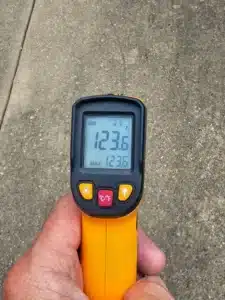
On a cloudy, 90℉ day in Frisco, Texas – 123℉ on the cement sidewalk!
Tips for Safe Outdoor Time
- Walk dogs early in the morning or after sunset.
- Provide shaded areas throughout the yard.
- Keep multiple water stations available.
- Use kiddie pools or pet sprinklers for cooling.
- Limit strenuous activity during peak afternoon heat.
- Test pavement with your hand before allowing your dog to walk on it.
A simple rule: If the pavement is too hot for your hand after seven seconds, it’s too hot for your dog’s paws. Simple rule #2: If your dog is doing the hot paw dance, it’s too hot for them!
The Deadly Danger of Leaving Dogs in Cars
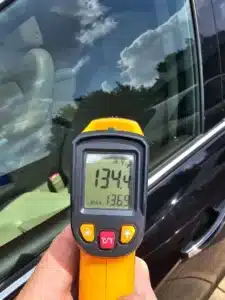
On a cloudy, 90℉ day in Frisco, Texas – 135℉ inside the car!
No summer pet safety discussion is complete without addressing hot vehicles.
Even on a mild day, the interior temperature of a vehicle can rise rapidly. Cracking the windows provides very little protection.
A vehicle parked in 85°F weather can exceed 100°F within minutes. On a 95°F day, interior temperatures can become fatal surprisingly fast.
Heatstroke symptoms include:
- Excessive panting
- Drooling
- Bright red gums
- Vomiting
- Weakness
- Staggering
- Collapse
- Seizures
Once a dog’s internal temperature reaches dangerous levels, organ failure can begin quickly.
The safest rule is simple:
Never leave your dog unattended in a parked vehicle—even for a few minutes. Really! Just don’t!
Can Someone Break Into a Car to Save a Dog?
Many pet owners are surprised to learn that several states provide legal protections for individuals who rescue animals from dangerously hot vehicles under specific circumstances.
Because laws can change, pet owners should always verify current statutes, but generally speaking:
California
California’s “Right to Rescue” law provides civil liability protections for individuals who follow specific procedures before forcibly entering a vehicle to rescue an animal in imminent danger. This includes contacting emergency services and following statutory requirements. (Justia Law)
Florida
Florida law provides civil immunity for individuals who enter a vehicle to rescue a domestic animal when certain requirements are met, including contacting law enforcement and remaining with the animal afterward. (The Florida Senate)
Tennessee
Tennessee law provides immunity from civil liability when a person follows specific legal procedures to rescue an animal believed to be in imminent danger inside a vehicle. (Reddit)
Oregon
Oregon has protections allowing intervention in certain circumstances involving animals in distress. Pet owners should review current state requirements before acting.
Texas
Texas has animal cruelty laws that prohibit endangering animals, but the legal protections for private citizens breaking into vehicles can differ from other states. Anyone witnessing a dog in distress should immediately contact local law enforcement or animal control. Of course, in Texas, if we see an animal cooking that’s not beef, we’ll rescue it!
Regardless of location, if you see a dog in apparent distress inside a vehicle, contact emergency services immediately.
Recognizing Heatstroke in Dogs
Heatstroke is a medical emergency.
Watch for:
- Heavy, frantic panting
- Thick drool
- Bright red or pale gums
- Vomiting or diarrhea
- Weakness
- Confusion
- Collapse
If you suspect heatstroke:
- Move your dog to shade immediately.
- Offer cool (not ice-cold) water.
- Apply cool water to paws, belly, and groin areas.
- Contact a veterinarian immediately.
Do not use ice baths, as rapid cooling can sometimes worsen the situation.
A Cool Dog Is a Happy Dog
Summer should be a season of fun, not emergencies. Whether you’re enjoying a backyard in Ventura County, walking trails in Salem, relaxing in Nashville, exploring Dallas, or spending time near the beaches of Palm Beach County, taking simple precautions can keep your dog safe and comfortable.
At Scoop Masters, we know that healthy dogs spend time outdoors. That’s why we help maintain clean, pet-friendly yards throughout California, Oregon, Texas, Tennessee, and Florida.
This summer, give your dog plenty of water, plenty of shade, and plenty of reasons to wag their tail—without risking their health in the heat.
With locations in Los Angeles, Ventura, Dallas, Austin, Houston, Nashville, Palm Beach and Salem, Oregon. Scoop Masters pet waste removal helps dog owners enjoy their yard again. Since 1988, we’ve been enforcing the “no flies” zone in backyards, patios and dog runs by keeping them dog poop free. We also offer a sanitizing service to help get rid of the smell on rocks, concrete and artificial turf. Contact us for a free quote. Follow us on Facebook and Twitter/X. If your dog can poop it, we can scoop it!